Trump signed order creating NIH women's health division
The Oct. 19 order also created a White House task force led by Susie Wiles and Robert F. Kennedy Jr. It did not specify new funding.
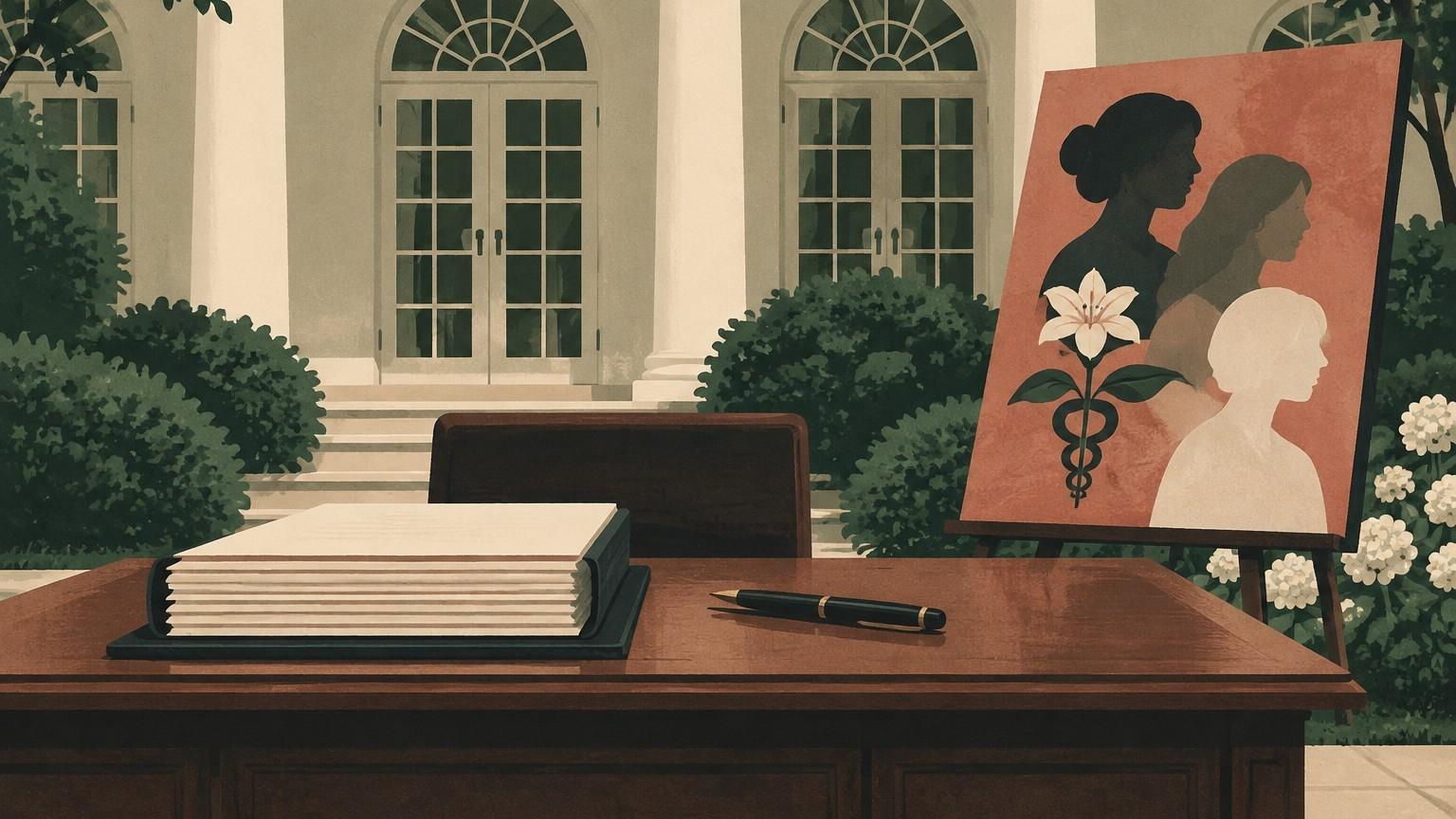
What the order creates
President Trump signed the executive order “Advancing Women’s Health to Improve Outcomes in All Phases of Life” on Oct. 19, directing the creation of a Women’s Health Division within the National Institutes of Health and a White House Women’s Health Task Force. The order sets no specific funding commitments.
The new NIH division is to be set up within 90 days, and the existing Office of Research on Women’s Health, established in 1990, will remain. An NIH spokesperson told STAT that the division would work with the existing office to broaden and coordinate research on understudied conditions at every life stage, better diagnose and treat them, include more women and girls in clinical trials, and to give greater weight to sex as a biological variable in studies funded by the NIH. HHS said the division will study heart disease, cancer, Alzheimer’s, autoimmune and inflammatory diseases, chronic pain, endometriosis, fibroids, polyendocrine metabolic ovary syndrome, infertility, maternal health, menopause, and osteoporosis.
The task force’s first session was scheduled for Oct. 19. Susie Wiles, the White House chief of staff, and Robert F. Kennedy Jr., the secretary of health and human services, lead the task force. Other members include cabinet secretaries, acting FDA Commissioner Kyle Diamantas, and CDC Director Erica Schwartz. HHS will cover the task force’s administrative expenses.
How the initiative reached the Rose Garden
First lady Melania Trump pushed the administration to prioritize women’s health and hosted the signing ceremony in the Rose Garden. She held a series of meetings with HHS officials, physicians and other public and private sector experts, and she said the order aims to “change the reality of women’s health.” In a statement, she said it was “abundantly clear that women’s healthcare needs to be modernized, the research gap closed, and further, the need to accelerate the discovery of treatments and cures was glaring.”
The initiative follows a dispute over NIH funding. On Sept. 21, Inside Higher Ed reported that the White House was considering an executive order to give the White House more control over NIH funding, after an Oval Office meeting with OMB Director Russell Vought, NIH Director Jay Bhattacharya and the president. A separate proposal would put political appointees more in charge of grants. Vought suggested that grant decisions undergo extra scrutiny, possibly by a commission whose members, including Vought and Bhattacharya, would have to agree unanimously. Congress had already delayed a separate OMB grants rule until mid-December.
Women’s health research has also been contentious. In February 2025, STAT reported that grants containing the word “women” were flagged for special review at NIH. A Washington Post analysis found that the number of competitively funded NIH projects mentioning women dropped 31 percent in 2025 under Secretary Kennedy. Sen. Susan Collins (R-Maine) said in April that “the administration’s emphasis on canceling diversity-related grants has resulted in less research aimed at women’s health.”
What is not settled
Trump’s order rescinds a March 2024 Biden executive order on women’s health research and a November 2023 White House memo that set up a women’s health research initiative. Common Dreams reported that Biden’s directives had helped obtain almost $1 billion in funding, and Trump’s order does not state what will happen to those existing funds. The White House has not given a dollar figure for research or treatment, and the NIH’s annual spending of roughly $5 billion on women’s health has remained steady regardless of administration.
NIH Director Jay Bhattacharya said the new division will “help close lingering evidence gaps, expand and maximize the impact of our research investments, and bring discoveries closer to patients.” But advocates said the unfunded order conflicts with the administration’s record. Dorianne Mason, who directs health equity and contraceptive access at the National Women’s Law Center, called it “blatant hypocrisy” and pointed to Medicaid reductions contained in the One Big Beautiful Bill Act, the defunding of Planned Parenthood, and reductions in women’s health research funding. Brad Woodhouse, president of Protect Our Care, said Kennedy has “tried to scrap any research grant or program that dares to fix women’s health disparities.”
Sources: Inside Higher Ed | Higher Education News, Events and Jobs, STAT, USA TODAY, Common Dreams, The Fiscal Times, Fortune
Celia Marchetti White House correspondent
Celia Marchetti covers the White House, presidential actions and nominations for West Wing Times. Celia writes from the documents the White House and the Federal Register publish, official statements and published reporting, and links every source.
Corrections. Report an error to corrections@westwingtimes.com. We list substantive corrections on the corrections page.